It was an armload of freshly cut quince branches which inspired us to write our very first Splendid Market post. So, it seemed more than appropriate to feature this favorite flower in our new banner.
As winter turns to spring many of us are spending more time in the garden, contemplating what could be… when thinking about plants and and landscapes, why not consider the quince?
Flowering quince (Chaenomeles) are a wonderful winter hardy, disease resistant, deciduous shrub which grow well in the northern states. The thorny, twisted branches become covered with masses of vibrantly colored coral, pink, orange or white blossoms in the late winter and early spring. As the blossoms fade, bright green leaves replace them. Finally, in the winter when the leaves give in to the frost, hard, yellow, waxy fruits are revealed.
At each of these stages, the nearly indestructible quince will provide you with many levels of elegant beauty and fragrance indoors and out.
In January, or early February, at the bud stage, quince branches can be cut and “forced” to bloom indoors. The warmth of the indoors entices the tight buds to open early and grace the indoors with delicate blossoms.
In our maiden post we created a massive display of tall branches, click on
flowering quince to read the post.
Short or tall, quince can always make an elegant arrangement. This year, we placed a couple of branches (about a foot tall) in individual glasses that made up a set.
En masse, or alone, the flowers float upon their dark branches and create an ethereal display.
Outdoors, hearty quince bring a flourish of color in the late winter through early spring.
Whether they are primly pruned..
or wildly reaching for the sky..
quince provide a beautiful display of color.
Quince are a great choice for a hedge. Their sturdy, dense branches provide privacy and beauty.
We love the shades of coral,
pink,
and orange.
But our favorite is always the pure white.
In the winter, the golf ball sized fruits which cling to the branches are beautiful. Their astringent, fruity fragrance is a fresh, natural room freshener (those in the photo below are fruits which were left on the branch). We display the fruit adorned branches in vases, or place the fruit in pretty bowls around the market.
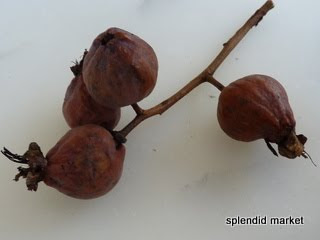
The fruits are hard and bitter. While they can be used to make marmalades and jellies, we think they are too small for the effort!
In past posts you may have read about the fruits from Quince Trees (
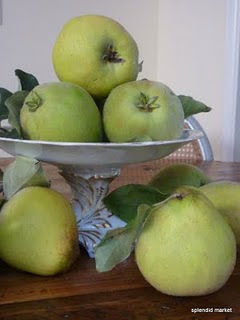
cydonia oblonga), or fruiting quince. These fruits are much larger than those from the flowering quince, we also love creating lusty displays of them around the market. To read more, click on
A Basket of Quince.
With a little more to work with, we find these larger fruits to be well worth the effort of slicing and preserving in a bath of vanilla syrup.
To read more about Quince Trees and other trees which bear decorative fruit, click on
Splendid Trees.
Happy Spring!!




I've never heard of quince. Thank you for teaching me something new today. They are beautiful and the variety of colors they come in provide for quite a bit of choice.